
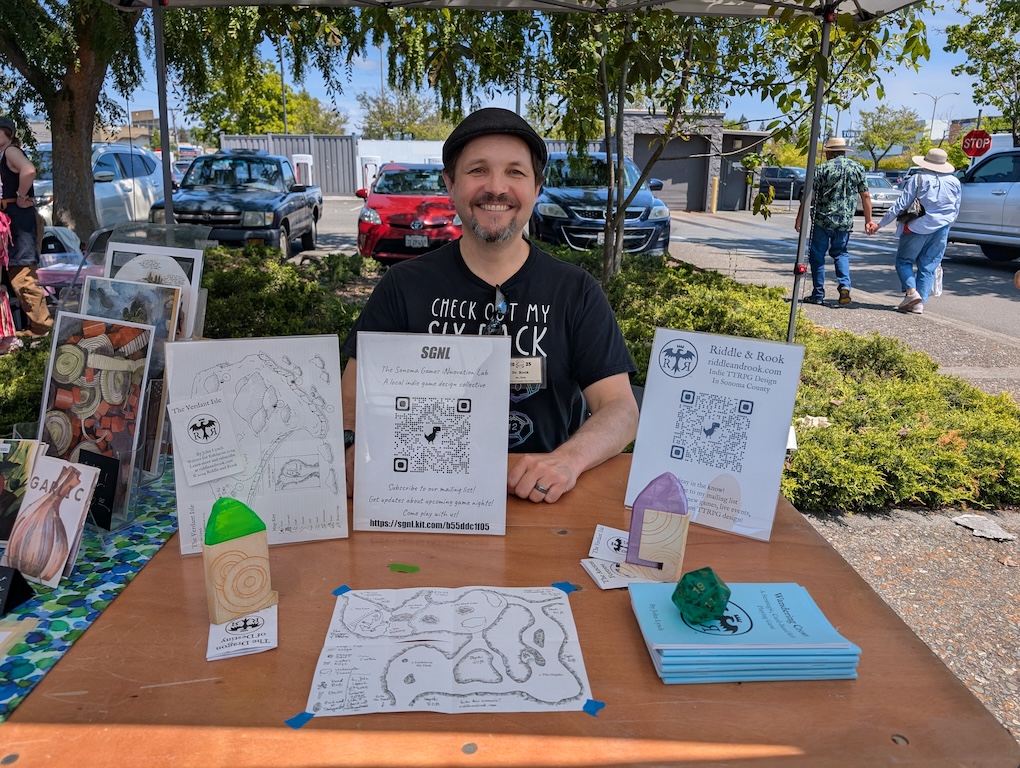
This past weekend was full of incredible gaming-related experiences. On Saturday, I tabled at Santa Rosa Zine Fest for the first time. I have to confess, I wasn’t prepared for it to be as amazing as it was. I thought that there might be a couple of dozen creators there, but apparently our Zine Fest attracts artists from across the Bay Area! And I was lucky to be seated next to the amazingly talented Julie Cardenas, who welcomed me into the community. (Check out her beautiful autobiographical comics!)

On Sunday, May 4th, I ran a couple of fun Star Wars-themed games under the SGNL banner. Happy (Belated) Star Wars Day, and thanks to my players for coming all the way up to Cuver in Windsor! I may share reviews of The Details of Our Escape and Galaxy Far Away (and Cuver’s yummy Midnight Gardener brew!) shortly.
For now, I want to talk about an approach to scenario design that I’ve been taking to adventure design lately, which I tentatively call “Billiard Table” design. DMs have been debating the merits of railroad adventures versus sandbox adventures for years, and I don’t want to wade into the arguments on the merits of each. That said, for the sorts of ultra-light games that I’m currently designing and playing, sandboxes are an absolute necessity: You don’t know what players you’re going to have and how much experience they’ll have, and it’s really easy for them to go sideways to your intended plan. For example, in my Galaxy Far Away game the other day, one of the players wanted to run a cheese shop but be lactose intolerant. I could not have predicted that my world would have to engage with that particular crisis prior to the game session. If my game scenario had been a railroad, it would have jumped the tracks, crashed into a starship fuel depot, and blown the whole scenario sky-high.
But how do you write a good sandbox? One that will flex to whatever your players want to do, without also making it really hard for you to figure out “what happens next?” For me, it’s a five step process:
- Brainstorm a cool environment with lots of cool potential encounter locations. Let’s say it’s an abandoned fort at the edge of an unknown continent. Could there be something hiding in the water offshore? Could there be a dungeon under the fort? Could the buildings of the fort hide hidden dangers?
- Come up with three or four “agents” who want something different in that environment, and whose needs conflict with each other. In the above example, maybe there’s a nobleman who will sacrifice his soldiers’ lives to find the magic treasures hidden in the ruins; a loyal captain who would sacrifice his own life to protect his soldiers, and is starting to worry about the nobleman; and (of course) the creepy beings living in the ruins, who want to eat everyone else.
- Make a list of likely reactions to likely player choices, to give you something to start with. If the captain recruits the players, what will he do if they report a monster attack? What will he do if they report that the noble is acting creepy? What might the noble do if he catches the players sneaking into his lodge and reading his notes about the cursed artifact under the ruin? Would he attack them or hire them? How many creepy beings need to die at the players’ hands before they storm the surface camp en masse? Don’t overthink it; just 2-3 per agent, to prime your creativity.
- Last but not least, toss an “inciting event” into that environment, usually in the form of the arrival of your players, that starts sending those agents bouncing off each other. (This is the billiard ball part of the metaphor.) If the players are able to kill some of the creepy deep dwellers, the captain will be thrilled, but so will the noble, because that gets him closer to his goal. Does he offer them a great reward to explore further? If another unit of soldiers dies exploring the ruins, does the captain stay loyal to the noble, or decide to betray him? If the deep dwellers storm the surface, do the other two factions team up, or does the noble use the chaos to sneak into the dungeon and find the treasure that he seeks? You don’t need to plan these actions in advance! Let each agent react naturally to the players’ actions. But let it be the players’ actions that drive the, well, action.
- Finally, have a clock handy in case your players get stuck or are spending so much time shopping for gear that you start to get bored. By a “clock,” I mean, a couple of planned inciting events that you can drop into the story whenever you want, that will shake up the billiards table, er, adventurescenario some more. In this scenario, I might have:
- A guard goes missing, and creepy tracks lead to the entrance to the ruin.
- The captain and the noble get into a shouting match in the mess tent.
- The creepy deep dwellers attack the camp at midnight.
The thing is, I don’t need to use these events. If my players decide to explore the ruins and we’re having fun in a dungeon crawl, great! Let’s do that one! If my players decide to go fishing and are having fun wrestling a giant octopus, cool! I’ll just be there! I just keep these events in my back pocket, so that if things start to slow down, I can easily get the story moving again.

I used this model in my Galaxy Far Away game this weekend, and it handled the fact that one player didn’t care at all about rescuing the imprisoned Jedi Knight, and the other player just wanted to sell cheese, just fine! We still told a great story about smuggling a Rebel agent out of an Imperial city while being chased by an Inquisitor. It’s also the model that I use in most of my Pocket Dungeons.
Let me know if you have any thoughts. I’m open to better ideas for a name, for sure. And I can’t imagine that I’m the first person to think of this, so if you can point me to designers who have done it better, please do.
Until we next roll dice together!